LED Retrofit Or New Fixtures: How the Decision Actually Gets Made
The fixtures already in the ceiling usually decide the question before budget does.
September 8, 2026 · 3 min read
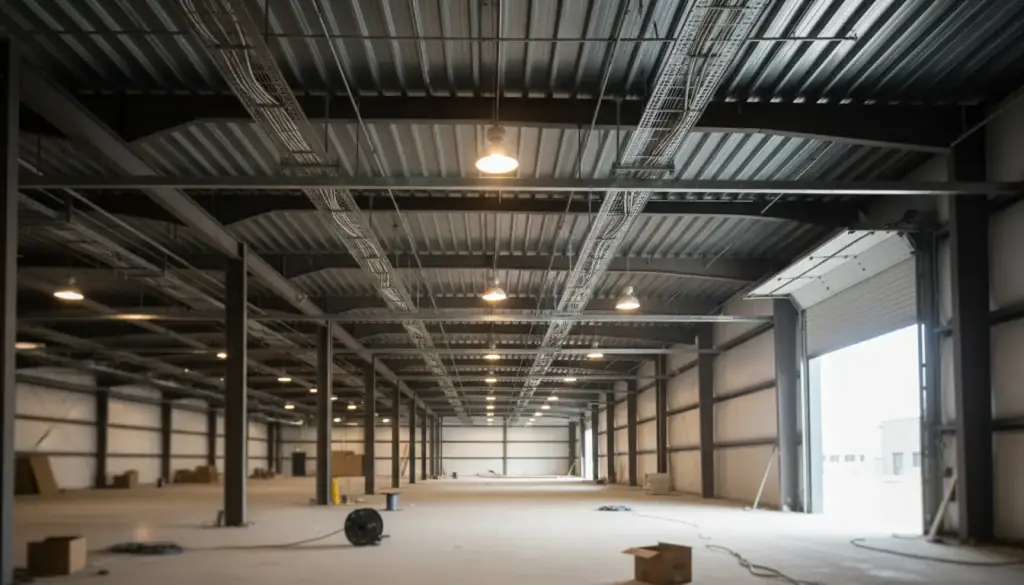
Office buildings, retail stores, and grocery stores rarely get to shut down for a lighting project. Whatever gets done has to happen around a space that's staying open, which is part of why the retrofit-versus-replace question matters more in a commercial building than almost anywhere else.
What changes with a retrofit versus a full replacement
An LED retrofit keeps the existing fixture housing in place and replaces what's inside it: the ballast, the tubes, or the driver, swapped for LED-compatible components. It's faster, less disruptive to an occupied space, and reuses fixtures that are still in good physical condition. A full fixture replacement takes the whole unit out, housing included, and puts in a new one. That's the right call when a fixture is physically damaged, when the lighting layout itself needs to change, or when a fixture is old enough that reusing the housing isn't worth the labor. Neither one is automatically the better answer. It depends on the condition of what's already up there.
A ballast failure looks different from a bulb failure, and comes first
A bulb failure is simple: the light goes dark, or it flickers on its own. A ballast failure shows up differently and usually earlier. Humming or buzzing from a fixture, flickering across several bulbs in the same fixture rather than just one, a fixture that's slow to start, or a faint burning smell near the fixture are all ballast signs, not bulb signs. It's an easy failure to misread. A building manager who keeps swapping bulbs in a fixture that keeps flickering is usually replacing the wrong part, because the ballast driving those bulbs is what's actually failing. Catching that difference early is most of what separates a straightforward bulb and ballast replacement from a fixture that keeps causing the same complaint every few months.
Lighting affects more than what a space looks like
Adequate lighting in an office or retail space isn't a cosmetic detail. It affects how productive a space feels to work in and how a store or showroom reads to a customer walking through it. Dim or inconsistent lighting from failing fixtures does the opposite of what a space is trying to project, whether that's a professional office, a well-run retail floor, or a hotel lobby.
How the decision usually gets made
In practice the choice comes down to a few concrete questions. Are the existing fixtures structurally sound, or are the housings themselves worn out. Is the failure isolated to a handful of ballasts, or is it showing up across most of the building at once, which usually points to age rather than a one-off part failure. Does the lighting layout still make sense for how the space is actually used, or has the floor plan changed since the fixtures went in. And how much disruption can the space tolerate while the work happens. A retrofit answers most of those questions when the fixtures themselves are fine and only the internals have aged out. A full fixture replacement answers them when the fixtures are the problem, not just what's inside them.
Age matters more than it might seem. Fixtures installed decades ago sometimes use a design old enough that a straightforward LED retrofit kit isn't really an option, in which case replacement stops being a choice and becomes the only real path forward. On newer fixtures with sound housings, a retrofit is usually the faster and less disruptive route, especially across a large office floor or a big-box retail ceiling where pulling every fixture down would mean days of ladders and lifts in the middle of business hours.
It also helps to treat lighting as something worth checking on a schedule rather than fixture by fixture as complaints come in. Regular maintenance and troubleshooting catches a ballast that's starting to hum well before it fails outright, and it's a lot easier to plan a retrofit across a whole floor at once than to keep sending someone out for one flickering fixture at a time.
What this covers in practice
This is standard interior lighting work: energy efficient lighting and LED retrofit, new lighting arrangement, office lighting, regular maintenance and troubleshooting, bulb and ballast replacement, and fixture installation, done in occupied commercial buildings without shutting the doors. Call (972) 620-1995 to have a fixture or a whole floor looked at.
North Town Electric — (972) 620-1995
Call (972) 620-1995More articles
The Three Signs A Commercial Breaker Panel Is Telling You Something
A commercial panel rarely fails without warning. These are the three signs worth acting on before it does.
Why Height Access Decides Who Can Work On Your Parking Lot Lighting
A dark parking lot or a dark sign isn't a wiring problem first. It's an access problem.